


The Righteous Mind - Why Good People Are Divided By Politics And Religion
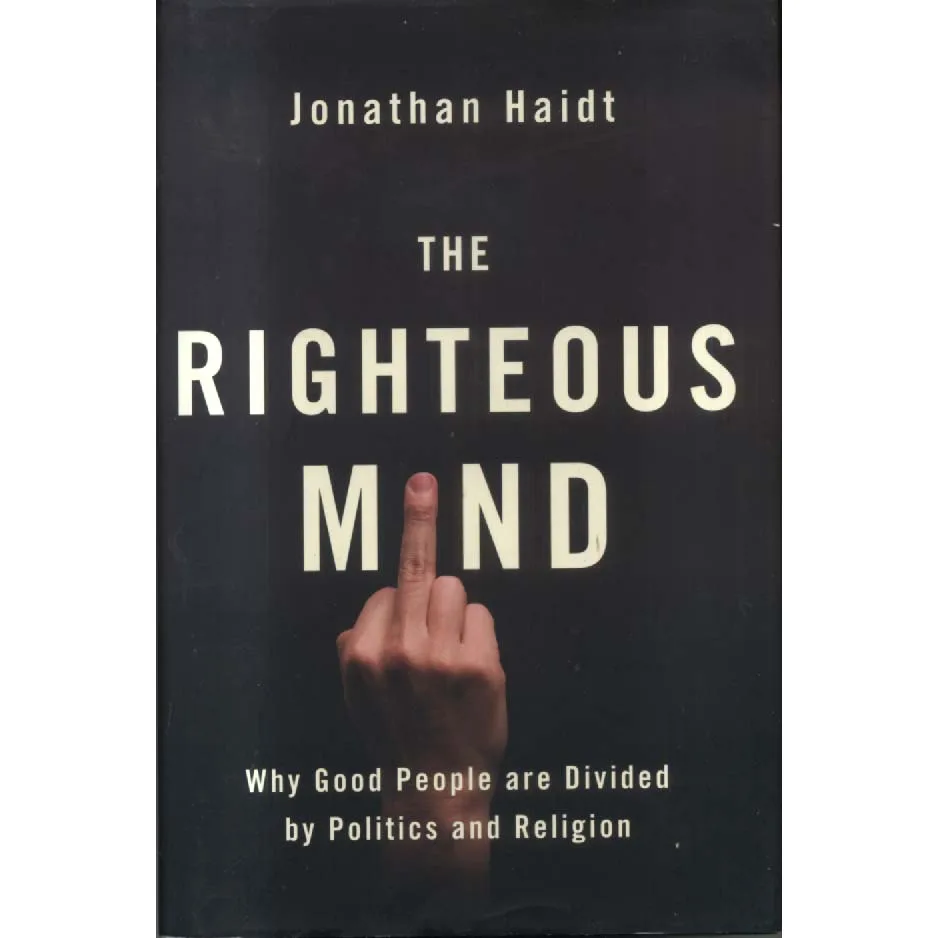
Publisher: Allen Lane
Format: Hardback
ISBN: 9781846141812
The Righteous Mind: Why Good People Are Divided by Politics and Religion (2012) – Jonathan Haidt
Allen Lane | ISBN: 9781846141812
Condition: Fine | Sold by Crappy Old Books
Politics and religion. Two subjects traditionally avoided at polite dinner parties, principally because introducing either can transform an otherwise pleasant evening into a shouting match involving accusations of stupidity, moral bankruptcy and the unfortunate possibility that somebody may never be invited back for Christmas.
But why do perfectly decent, intelligent people disagree so violently about what is right and wrong? Why can one person’s moral certainty appear to another as breathtaking ignorance? And why does everybody seem convinced that their own opinions are the product of careful reasoning, while everybody else’s are the result of prejudice, manipulation or insufficient education?
In The Righteous Mind, social psychologist Jonathan Haidt sets out to explain this magnificent human capacity for moral disagreement, arguing that our political and religious convictions are shaped by psychological forces considerably more complicated than simply deciding which side has the best arguments.
His central proposition is deliciously uncomfortable: human beings are not primarily rational creatures who carefully examine evidence before reaching moral conclusions. Instead, intuition usually gets there first, leaving reason to arrive afterwards with a briefcase full of elaborate justifications.
Haidt illustrates this relationship through his memorable metaphor of the elephant and the rider. The elephant represents our powerful moral intuitions, while the rider represents conscious reasoning, which frequently imagines itself to be in control despite spending much of its time explaining why the elephant has wandered off in a completely different direction.
The book also introduces Haidt’s influential moral foundations theory, exploring how people attach differing importance to values such as care, fairness, loyalty, authority, sanctity and liberty. These variations help explain why conservatives, liberals and other political groups can examine the same issue and reach dramatically different moral conclusions.
Naturally, each side tends to assume that its opponents must be either dishonest or spectacularly dim, rather than considering the unsettling possibility that different people genuinely experience the moral world in different ways.
Religion receives equally fascinating treatment. Haidt explores how shared beliefs, rituals and moral communities can encourage cooperation and solidarity, while simultaneously creating powerful divisions between those fortunate enough to belong to the correct group and those whose principal failing is having joined the wrong one.
Drawing upon psychology, philosophy, anthropology and evolutionary theory, Haidt challenges readers to reconsider the origins of their own convictions. His arguments are provocative rather than universally accepted, but they provide a stimulating framework for understanding the tribal instincts underlying so much public disagreement.
Published in 2012, before subsequent years demonstrated quite how enthusiastically political divisions could be amplified by social media, The Righteous Mind remains a particularly thought-provoking examination of moral psychology and ideological conflict.
This 2012 Allen Lane edition, offered in Fine condition by Crappy Old Books, is an excellent acquisition for readers interested in psychology, politics, philosophy, religion and the extraordinary difficulty of persuading other people that they’re wrong.
A fascinating investigation into why good people disagree, why arguments so rarely change minds and why moral certainty can be such a dangerous luxury.
Because everybody likes to believe they’re riding the elephant of reason.
Unfortunately, most of us are simply hanging on while it charges confidently towards whatever we already believed.
Keep browsing: See more Politics books Other books by Jonathan Haidt
